

I’m not sure when the idea germinated. If pressed, which I am because I’ve been asked to write this story and have a deadline, I’d probably say it was sometime during the pandemic. I was on-site at a construction meeting in Brooklyn the day they announced New York City had hit 20,000 daily Covid cases; after that, it was months spent staring at tiny glowing images within the edges of a digital screen, evenings passed lying in the exact same position inside my house, killing time in a country that I could not leave even though I wanted to: walls inside walls inside walls. Somewhere in that span I’m sure there was an image or video that made me think that Marseille seemed kind of nice.
When the vaccine was finally available, the first thing my husband and I did was book a trip to Paris. Since we were so close, we figured why not Marseille, too? The initial thinking was that a long weekend would break up the trip nicely. We’ve been back to France every year since, and now we invert that ratio.
Most of the time we take the TGV down from Gare de Lyon, and I always feel happy looking around at the crowd that remains after the Aix-en-Provence stop, a mix of bodies and faces that I can never quite predict. Without fail, the scene at Saint-Charles is anarchy, its cathedral ceilings soaring over a throng of people; outside, the station sits at the top of a large hill on a Haussmann-esque boulevard, but all this grandness is tempered by the fine layer of dust that coats every surface, as if the whole city were covered in a perpetual dusk even on the brightest day. We rent our car from here, in a sleepy little auto center tucked around the side of the building.
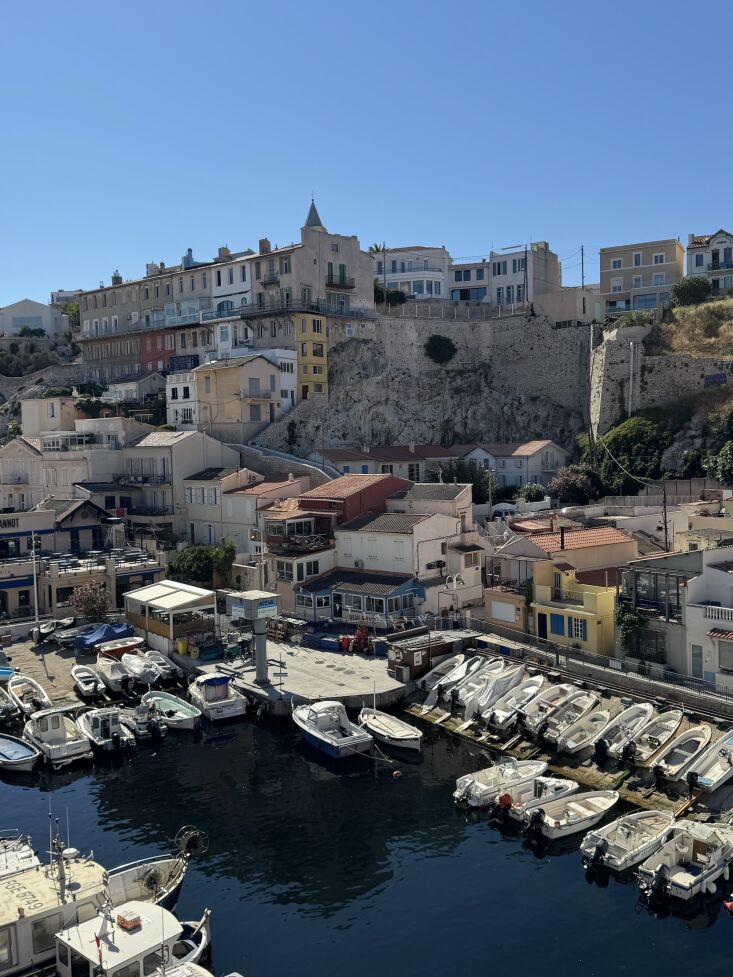
Veering off towards the left we find the Cours Julien in a state of perpetual punk, where tattooed youth trade pierced tongues on the public square; you can also have one of the best meals of your life at Livingston. When you go, you will most definitely be seated on the street surrounded by graffiti and loud music, and there’s some decent gelato down the road and the kind of vintage shopping that doesn’t require you to have more than 20 euros in your wallet.
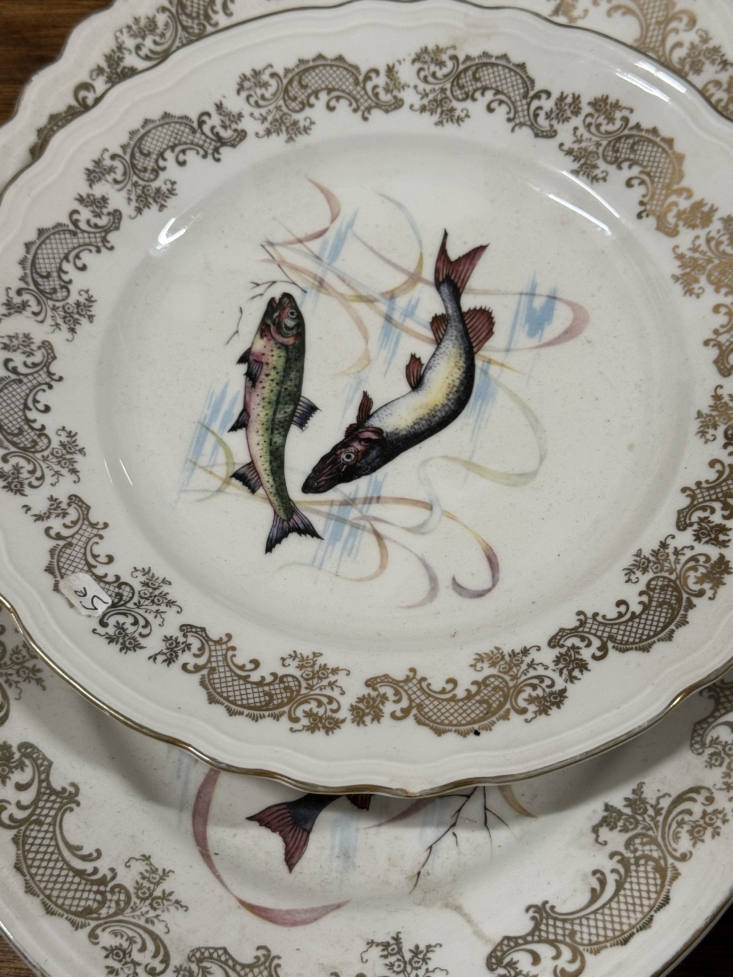
Further down from here is Vieux-Port, which has been in operation since 600 BC. Marseille is France’s oldest city, and even though the cruise ships stationed in the harbor smack of the 21st century, there are still areas that feel like we might have landed in Morocco a hundred or so years ago. Following our annual pilgrimage to Maison Empereur for all types of useful things that we do not need, we always stop at a small stall with an open-air kitchen for mahjouba, a savory Algerian bread that’s somewhere between naan and a crepe, stuffed with tomato paste and peppers. It’s served at a temperature that is guaranteed to scald our tongues since we cannot help but wolf it down.
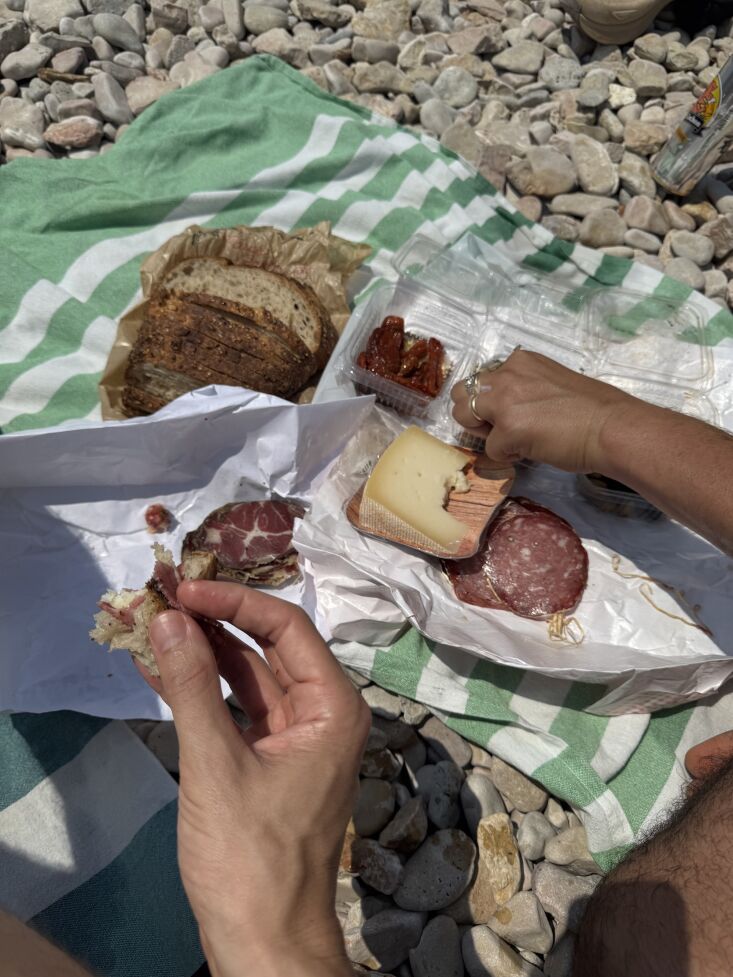
Out of sight but just over the hill is another ancient port on a much smaller scale called Malmousque. Its busy thoroughfare, La Corniche, has plenty of other spots worth dipping into (Kennedy for fresh seafood, Cecile’s for a classic sandwich), and you’ll be surrounded by hip creative types with freshly lit cigarettes who will undoubtedly be wearing something they just picked up from the concept store Jogging, or at least something that resembles an item they would have liked to pick up from Jogging. The added benefit of this location is that after a short walk through what used to be a fishing village—all white stucco huts smothered in bougainvillea and tamarisk blooms—you can eat lunch by the ocean, as long as you’re brave enough to scramble over the rocks. One of life’s greatest pleasures is to sit on those rocks and eat a sandwich between swigs of cold beer with two feet dangling in the Mediterranean, trying not to think about how much you miss cigarettes.
Following the coastline south, we pass a mosaic of classic, postmodern, and contemporary architecture that doesn’t make any sense. Squinting we can see the charmingly dilapidated Rococo garden at Villa Santa Lucia up in the hills of Roucas Blanc, its sequence of terraces tumbling towards the sea. Eventually we come to the roundabout with the Statue of David. It’s not the real deal, just a replica gifted to the city in 1903 that for some reason took almost 50 years to place. If we were to take a left, which we aren’t on this journey, we could catch a glimpse of La Cité Radieuse by Corbusier, a presumed attempt to bring his personal brand of order to a city whose motor seems to run on sustained low-grade chaos.
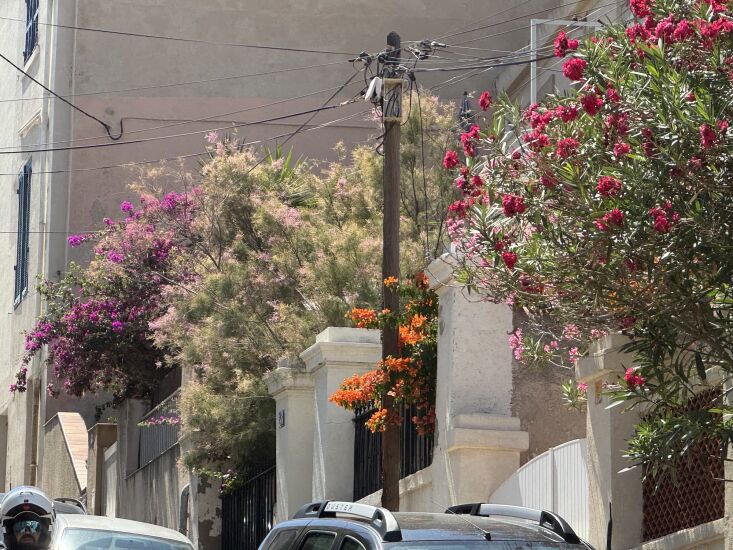
For our trip we are headed straight with the windows down, further into the sprawling 8th arrondissement: past the long stretch of boardwalk, beyond Librairie MiMA, where I’m always tempted to buy a beautiful monograph whose captions I cannot read to flip through at the beach, but only after a satisfyingly greasy burger at Cabanon de Paulette. Finally we arrive in the postage-stamp-sized neighborhood of Samena. It’s here where my husband and I stay every year, at Villa d’Orient: a small, unpretentious bed and breakfast in a tiered Deco building with stained-glass windows and a stony courtyard full of cycads and agave. Run by our friends Pascal and Jean-Marie, it makes me sad to say that it is up for sale, and my selfish side is screaming at me not to write about it even as I share it with you now. In the evenings, you can walk up the large flight of concrete steps at the end of the street and look out at the vast expanse of mountains and sea. The bustling two-lane road here leads down to trendy Les Goudes, its precipitous edges set against a horizon so orange it practically tastes tangerine.
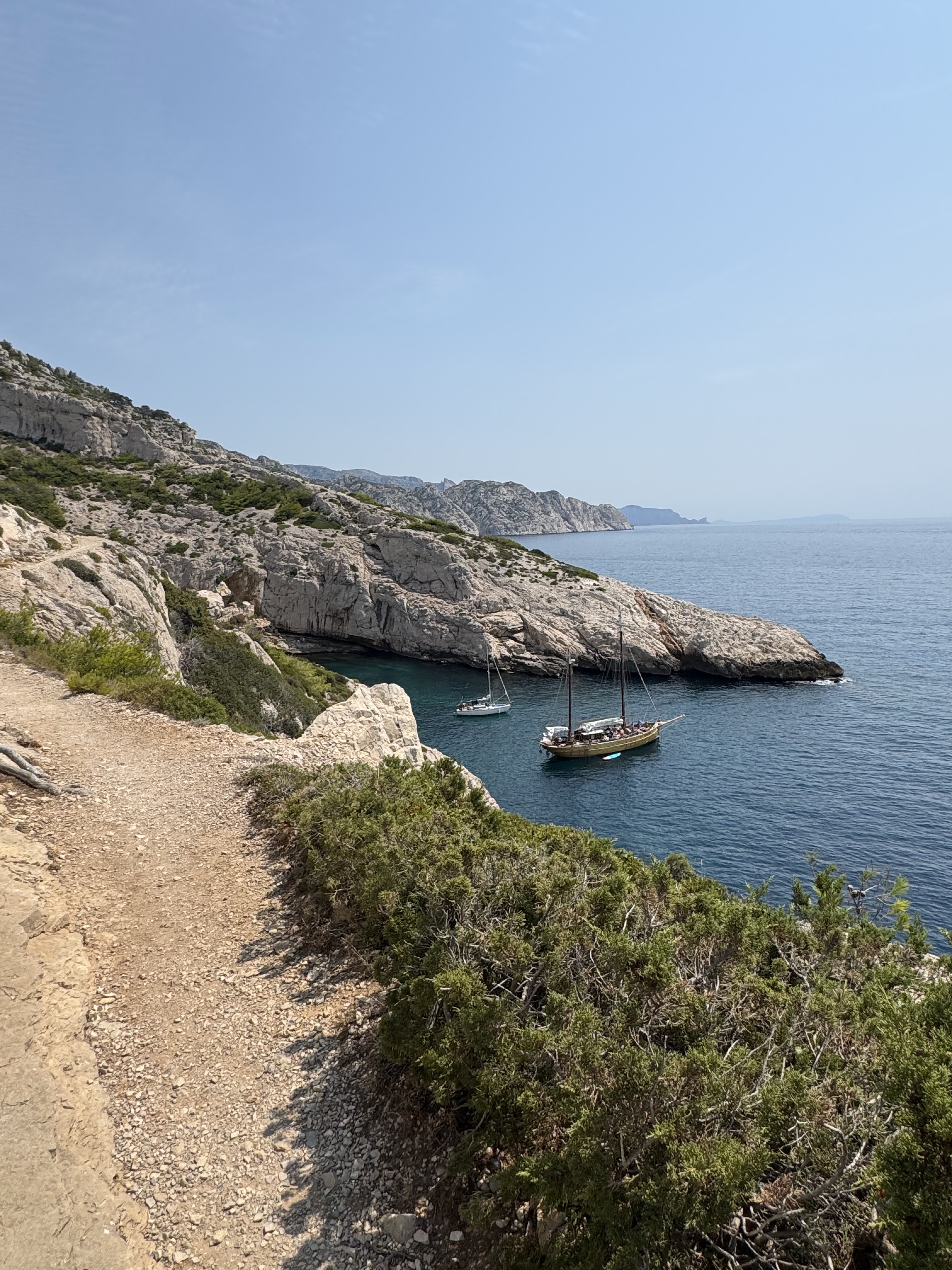
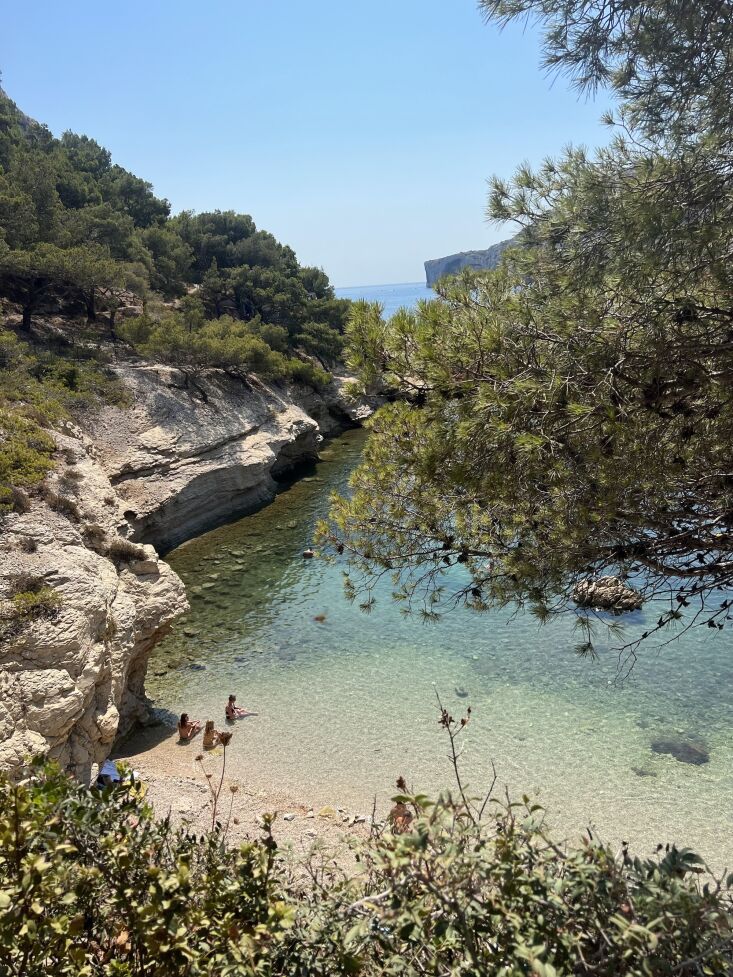
The neighborhood sits at the entrance of Parc National des Calanques, which has some of the most beautiful beaches and punishing hikes that I have experienced. The calanques themselves are little bays that have been gouged into the limestone cliffs over time, and even though it’s possible to take your car inside several if you book in advance, it’s best to journey on foot. It’s the only way to experience the smell of juniper baking in the sun and the pulsating rhythm of cicadas. Occasionally, you might stop to marvel at a native artemisia, or just take in the view, or exchange polite words with other hikers sipping water and suffering through it. Eventually the path becomes a descent, and the beach is revealed.
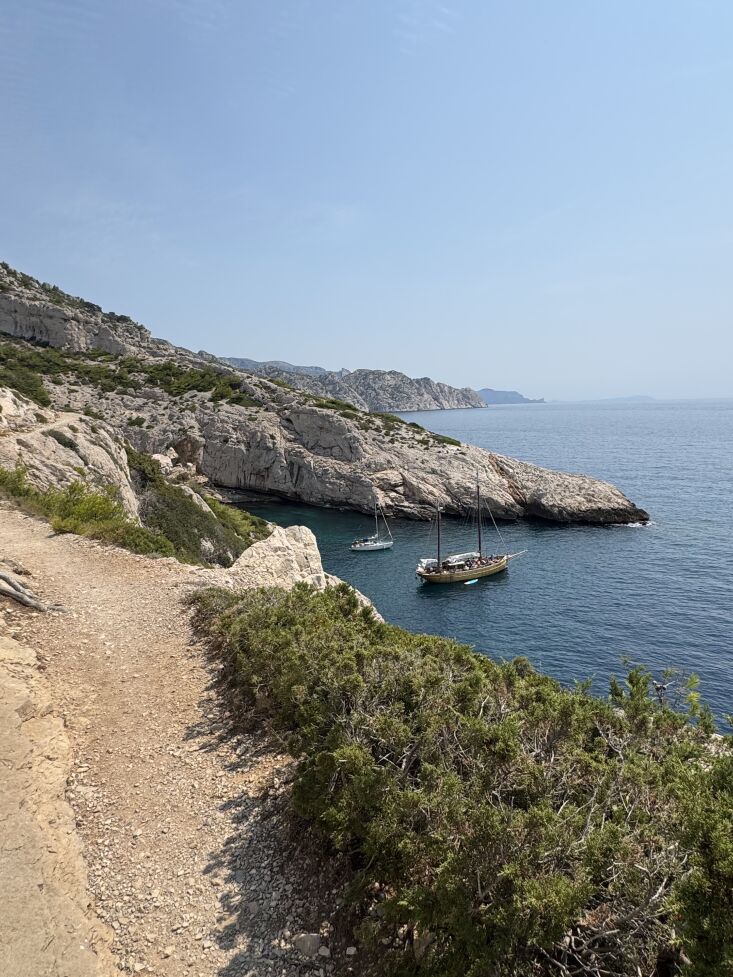
Many of the larger calanques—Morgiou, Sormiou—have little restaurants where ice is scarce and utensils are even scarcer, forcing us to gulp ice cream down in a way that gives us each a brain freeze but also brings a shocking clarity to the day. Sometimes there are dogs lollygagging around in the water that make me miss my own. Beachgoers set their blankets down anywhere there is a decent amount of horizontal space, and the people-watching is bar none: women in burkinis next to Eastern European men in speedos; muscular teenagers with barely there peachfuzz moustaches; toddlers supervised by trios of ladies clearly gossiping in languages we can’t understand; French grandmothers; Algerian grandfathers. So much humanity crammed into one place at a time when it’s hard not to feel that it is leaching from this world. This is why I keep returning. I really should book my flight.
N.B.: Photography by Nick Spain. And for more of Marseille’s vibrant design scene, see:

Error: No connected account.
Please go to the Instagram Feed settings page to connect an account.
Have a Question or Comment About This Post?
Join the conversation