How to turn a small, dilapidated single-story former saloon from 1888 into a modern family home for a design-minded couple and their two young children?
Photograph by Joe Fletcher, courtesy of Ryan Leidner Architecture
“We had very strict guidelines from the Planning Department regarding how the buildings would relate to each other (mainly in terms of height as the new house couldn’t be taller) and the amount of open space we kept between the structures,” he explains.
The street view, with a peek of the new building, painted white.
The Exterior
The street entrance opens into the private courtyard.
The Old Building
The original building was painted a midnight blue “to create more of a dynamic contrast to the new structure, painted white,” says Ryan.
“I’m regularly inspired by Japanese and Scandinavian design, and the tradition of respecting natural materials, the craft of building, and the beauty of a well-considered space,” Ryan says of his design sensibility.
The older building was reimagined for easy entertaining, something the clients do often.
The white oak dining table and wall storage system were built by the owners’ good friend, Anthony Zollo of Studio Zollo. The dining chairs are by Borge Mogensen.
An onsen-inspired bathroom features a hand-painted mural of bathers by local painter Rob Moss Wilson.
The cedar-lined outdoor shower and bath.
The New Building
The new two-story structure, designed with its own open living room and kitchen. A fig tree grows in the center of the courtyard.
The windows and doors are from Quantum Windows & Doors.
The white-oak cabinets in both this building and the older one are custom.
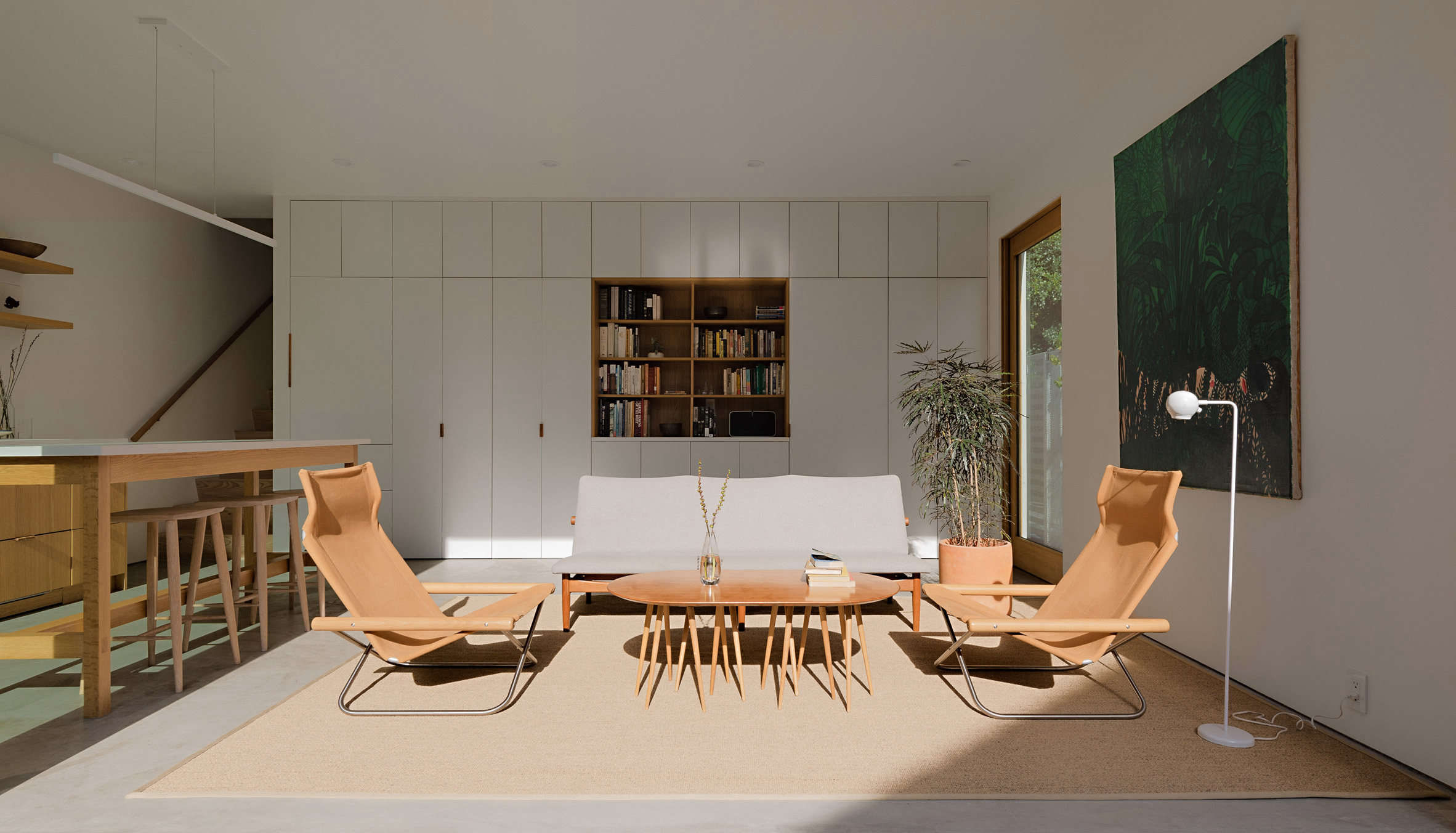
Concealed in the wall of cabinets is a powder room. The “Japan Sofa” by Finn Juhl, a multi-legged coffee table, and a pair of armchairs by Takeshi Nii—all vintage—make up the living area.
Private living quarters comprise the second floor: two bedrooms (pictured is the master bedroom) and a bathroom.
Off the nursery is a lightwell, which offers an easily accessible outdoor space and fresh air.
“The extruded white oak window boxes on the new structure give a nod to the more traditional approach to window casings while making them more three dimensional,” notes Ryan.